Showing posts with label arica. Show all posts

Saturday, 5 January 2008

One night in Codpo

Thursday 3rd January

It rained heavily last night. We’d had another exceptional meal of cold spaghetti and boiled, frozen veg again last night.

At breakfast they gave us coca leaves and some other herbs to help with altitude sickness, or maybe it was to help obliterate the memory of some of the worst coffee we had had so far. (And that is saying something, in even the posh hotels, you only get instant coffee.)

We set off back to Arica. On the way we passed the Pukara de Copaquilla, an Inca fortress with typical round houses from around 1000 b.c.


On the way we decided that we didn’t want to stay two night in Arica, but would rather see some different places. We cancelled our hotel and then went into the centre to have a decent meal, as we didn’t know what we would get later.


We saw several car transporters taking old cars to Bolivia.


On the way to Arica we had seen a sign to a village which seemed to have lots of facilities. After about an hour, we saw the sign again and headed inland. 47 km later, we reached Codpo, a small oasis town, deep in a valley.


To our surprise there was a tourist information office and it was open. We’d seen a sign for a hotel on the way in, so we asked if there were “habitaciones” available. We were shown to a room off a road in a side street. The wife of the tourism officer came and changed the linen, and we paid the pricely sum of 13,000 pesos ( about £13). The officer seemed very concerned about our dinner so he took us to the restaurant, which was shut, and arranged for it to be opened up for us.

Back in the room, there was no electricity, though there were light switches and fittings. Unlike Colchane, they had provided candles and matches. You could see daylight through a crack in the wall, though inlike Tocopilla this was mostlikely caused by bad construction and not an earthquake.


We did a “pasiendo” (walk) around the town and saw the tourism officer on his bike. He seemed also to be in charge of the village water supply, which he explained had been installed a year ago, and came from bore holes. He then went off to feed his livestock.


We saw fig trees, lime trees, grapes and other things being cultivated in a rather ad hoc way. There were also sheep and pigs.

On the way back into the village, the tourism officer was there again talking with the local Carabinero, no doubt telling him about our arrival. He had previously explained that once some French and German people had visited the village, but we were the first English.

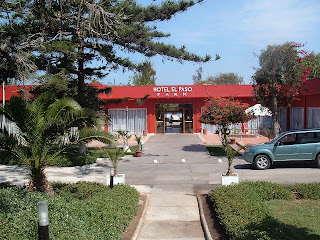
On the edge of the village, we found a sizeable hotel complex, complete with modern buildings and a pool, but it was closed up.

At 8.30 p.m., we turned up at the restaurant which was in darkness, apart from a couple of lightbulbs. We were served a meal of rice, lettuce, raw tomato and avocado with hot bread. Miraculously at 9 p.m. all the light came on, and the proprietress explained that there was electricity for three hours per day. At other times, a generator is used.

The meal with wine came to £3. Back at the room, the lights were like Blackpool Illuminations, but for the third time only in Chile, there was no WiFi.

Then the electricity went off. We had only had one and a half hours.

Tuesday, 1 January 2008

Back up into the altiplano


The church at Putre

Tuesday 1st January 2008

As ever we did not get away from the hotel until late. After last night’s partying the streets of Arica were very quite and almost all the shops were shut. But most importantly the botilleria was open, so we bought some Cab Sav and headed off into the hills. Initially we went the wrong way, but eventually we found the road leading up to Putre and eventually Bolivia.

Initially the route inland was quite lush with tomatoes and maize being grown. We even passed a hostel specialising in vegetarian food and yoga. Pretty soon though we were rising into the arid mountains, though the road was remarkably good. We managed to avoid the occasional mad Bolivian bus, but apart from that there was little traffic on the road.

Imagine our horror though when we noticed some wet stuff on the windscreen!! Kevin struggled to find the wipers as we hadn’t had to use them so far. We are staying the night in Putre which is about 3600m above sea level. A lot of people stop here before going climbing in the Andes, to acclimatise to the altitude.

The hotel is a modest series of bungalows. A cat, very similar to Molloy, was on the door mat as we came in.


The view from our bedroom

We waited until the rain eased off before heading into town. Putre, like Arica, was closed, but hopefully tomorrow it will return to the buzzing town described in the guidebook. Though closed, there is even a restaurant specialising in vegetarian food.


A traditional building. The grass hides the corrugated metal roof.
We spotted a sign saying “We have fuel”, so hopefully tomorrow we should be able to fill up and go and explore Parque Nacional Lauca, with its Christmas Pudding volcano (currently covered in cloud.)

We were pleasantly surprised to find that there is both electricity and WiFi here.

New Year's Eve in Arica


A pelican


Monday 31st December

After another late start, but this time without missing breakfast, we went for a walk around Arica. There is a railway on the front that still takes passengers to Bolivia. An old steam engine stands outside the old station.


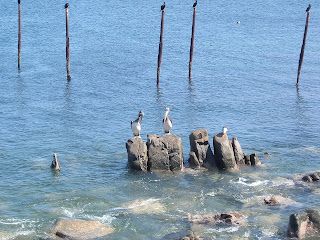
We went to the dock, where they gut and sell fish on the quayside. As a consequence of this, the area is inhabited by hungry pelicans and some of the fattest sea lions ever. They hang around waiting for scraps to be thrown into the sea.


There are boat trips around the harbour, and we caught one. We went past the fishing fleet, which has some larger trawlers, unlike Pisagua.


There was an old boat moored that has now been completely overtaken by pelicans, who have made a real mess.


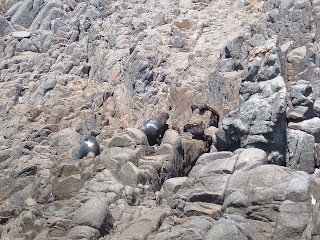
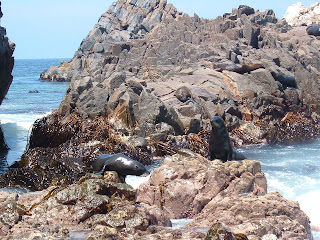
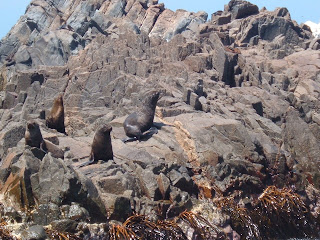
Then we went past some buoys where lazy sea lions basked in the sun.


Back at the port, the harbour was full of big jellyfish.


Apart from the fish market, there isn’t much on the front. No cafes or bars. Therefore we headed back to the main pedestrian area which was packed with visitors.

On the way we went past a church, Iglesia San Marco, designed by Gustav Eiffel. Made completely of iron, it was prefabricated and assembled in France, before being dissembled and shipped to here. According to the guide the riveting key was kep in a display case in side the church, but during the nitrate wars, the Bolivians threw the key into the sea for fear that the Chilean invaders would disassemble the church and take it as a war trophy. However the Chileans did not need to do that as they won the war and the whole of El Norte Grande.


We then took lunch at a busy café, before heading back to the hotel for a rest.

There was a big party in preparation at the hotel, next to the pool and we were glad that we had changed rooms to somewhere more tranquil.

Just before midnight we went out and watched the New Year fireworks display at the top of El Morro, a huge cliff which dominates the town. The midges were out.

Back at the hotel the festivities were in full swing and voice. We cracked open a bottle of Chilean fizz………

Happy New Year to all our avid readers!

Monday, 31 December 2007

Pisagua to Arica


Sunday 30th December

During the night we could see people wandering around looking for the source of the electricity cut. It seems that the local Caribineros usually sort it out, but this time they had to get someone from the city, which we assume is Iquique, about 200 km away.


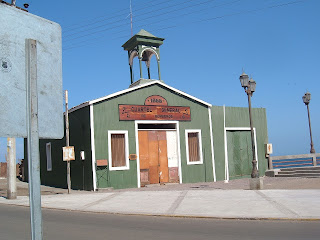
The old Fire Station

By the morning the lights were back on. We had breakfast and signed the visitors’ book for the landlady. She wanted to read our guide book, and was appalled at how out of date it was. We promised her that we would email Rough Guides when we get back, and ensure everyone knows about her hostel.


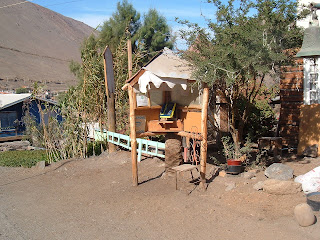
Public phone box outside La Roca

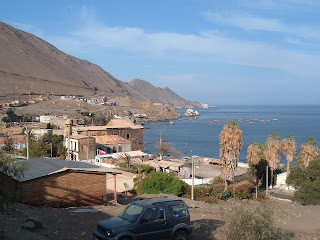
View from our bedroom

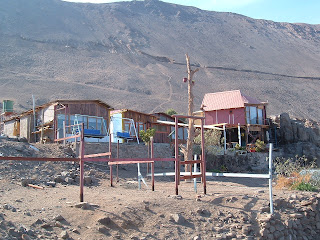
View of our bedroom on the left


We then set off back to the headland to video the sea lions, or “lobos” (wolves). On the way we heard a racket come from the sea, and saw an armada of pelicans, who were bossing the seagulls about.


On the pier, people were buying fish, but not in bulk, one or two per person.

It was much hotter this time, but we still made it down to the shore. The sun was in a better place. We did quite a bit of filming and took some better photographs. Sea lions seem to love playing around in the incoming waves – a bit like humans.


As we made our way back along the narrow track on the edge of the hillside, a 4X4 came along and offered us a lift. As it was so hot we did not think. The man was obviously a local, as he drove precariously close to the edge, up and down the very bumpy track. We both held on tight and leant towards the hillside, as if that would make a difference.

Kindly he dropped us off at the hostel, where the Landlady was keen to offer us a beer. We tried to explain about not drinking and driving, and politely refused.

Finally we set off. On the way out of town we visited the cemetery. We are told that there are many British people buried there from the nitrate era, but the names on the graves have disappeared. It was quite a dilapidated place, and quite gruesome as you could see collapsed coffins. We didn’t want to look in!!

However the most terrible thing about this cemetery came at its furthest point.

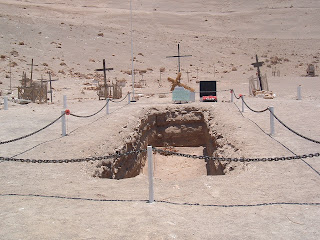
During the initial years of the Pinochet regime (11 September 1973 – 1990), Pisagua was used as a concentration camp for the local leaders of the opposition Socialist Party. Socialists were incarcerated in the Pisagua jail, tortured and falsely accused of crimes to justify their treatment. About thirty individuals were either shot or had their throats cut in the graveyard or thereabouts, including a fisherman and a young boy who had nothing to do with politics. In some of the cases, their corpses were blown up to conceal their executions. Many of the families have still not had the chance to bury their relatives.

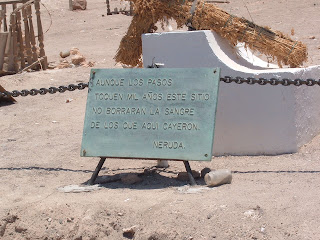
There is an open pit in the graveyard where they excavated some bodies. It has some words by Pablo Neruda above it, the famous Chilean poet, and roughly says that thousands of years could not wash away the blood spilt here.


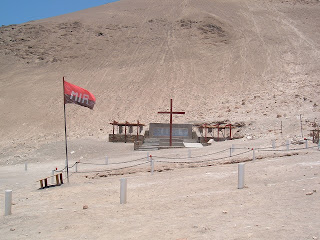
More recently (last year) a new monument has been erected giving the history of the site, and the names of those known to have died whilst incarcerated at Pisagua.


After visiting this sad place, we left Pisagua, up the steep track again, and headed north to Arica. There isn’t much along the Ruta 5, not even a petrol station. Just a few posada, or truck stops.


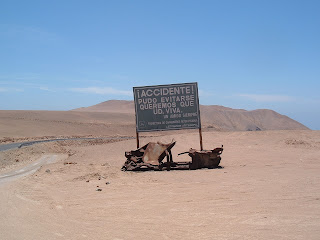
A subtle Chilean warning sign


The Ruta 5 has been mainly flat across the nitrate pampa, but towards Arica, it goes down and up steep hills, high above deep valleys. There were loads of mad bus drivers, hurtling their way to Iquique and Santiago, which is almost a full day’s drive from here.

Eventually we descended into Arica, which is more like a city than Iquique and Antofagasta. Our hotel is on General Valasquez, near the port. To date, we have been used to half deserted hotels, with a few mining engineers or European tourists for company. Here it is packed with families, who mainly seem to come from Bolivia.


Initially they gave us a room overlooking the pool, but there were loads of kids, music blaring and no privacy, so we asked to change and were given a suite of rooms in the rear of the hotel with two bathrooms and a Jacuzzi.

We walked into town, which was bustling with street traders and taxis. As usual there wasn’t much choice for veggies, so we ate Italian in a wooden building, on a corner. It must have been the worst Italian in the world. Kevin initially ordered “cerveza national” (local beer) and was told they only had Mexican. Joan asked for a wine list, referred to on the main menu, and was told there was no wine. Joan ordered a Pizza Ecologico and they did not have the ingredients. And then when we asked for pepper, they had none of that either. We won’t even talk about the “banos” (toilets.)

We didn’t stay long!!!