
During the night we could see people wandering around looking for the source of the electricity cut. It seems that the local Caribineros usually sort it out, but this time they had to get someone from the city, which we assume is Iquique, about 200 km away.
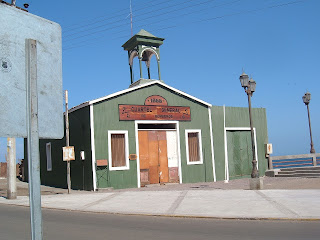
By the morning the lights were back on. We had breakfast and signed the visitors’ book for the landlady. She wanted to read our guide book, and was appalled at how out of date it was. We promised her that we would email Rough Guides when we get back, and ensure everyone knows about her hostel.
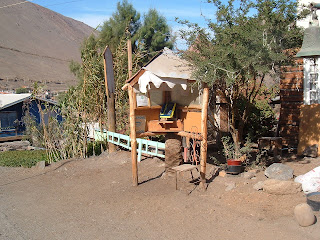
Public phone box outside La Roca
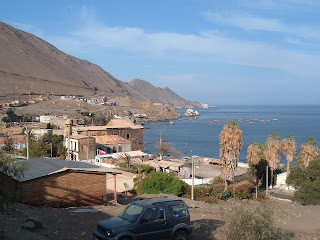
View from our bedroom
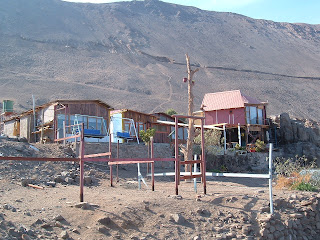
View of our bedroom on the left
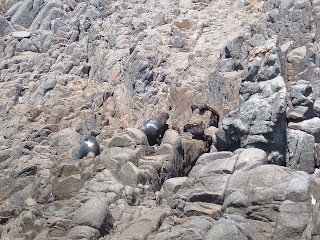
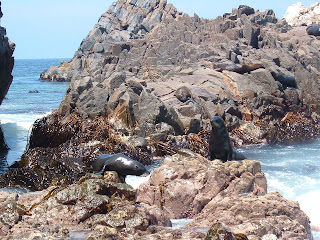
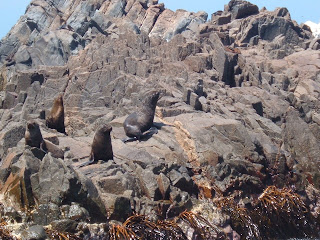
We then set off back to the headland to video the sea lions, or “lobos” (wolves). On the way we heard a racket come from the sea, and saw an armada of pelicans, who were bossing the seagulls about.
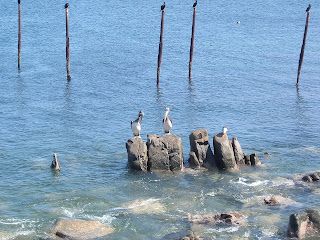
On the pier, people were buying fish, but not in bulk, one or two per person.
It was much hotter this time, but we still made it down to the shore. The sun was in a better place. We did quite a bit of filming and took some better photographs. Sea lions seem to love playing around in the incoming waves – a bit like humans.
As we made our way back along the narrow track on the edge of the hillside, a 4X4 came along and offered us a lift. As it was so hot we did not think. The man was obviously a local, as he drove precariously close to the edge, up and down the very bumpy track. We both held on tight and leant towards the hillside, as if that would make a difference.
Kindly he dropped us off at the hostel, where the Landlady was keen to offer us a beer. We tried to explain about not drinking and driving, and politely refused.
Finally we set off. On the way out of town we visited the cemetery. We are told that there are many British people buried there from the nitrate era, but the names on the graves have disappeared. It was quite a dilapidated place, and quite gruesome as you could see collapsed coffins. We didn’t want to look in!!
However the most terrible thing about this cemetery came at its furthest point.
During the initial years of the Pinochet regime (11 September 1973 – 1990), Pisagua was used as a concentration camp for the local leaders of the opposition Socialist Party. Socialists were incarcerated in the Pisagua jail, tortured and falsely accused of crimes to justify their treatment. About thirty individuals were either shot or had their throats cut in the graveyard or thereabouts, including a fisherman and a young boy who had nothing to do with politics. In some of the cases, their corpses were blown up to conceal their executions. Many of the families have still not had the chance to bury their relatives.
There is an open pit in the graveyard where they excavated some bodies. It has some words by Pablo Neruda above it, the famous Chilean poet, and roughly says that thousands of years could not wash away the blood spilt here.
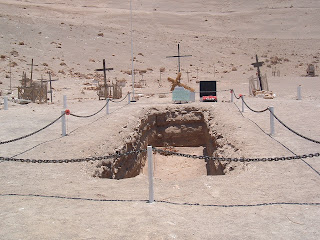
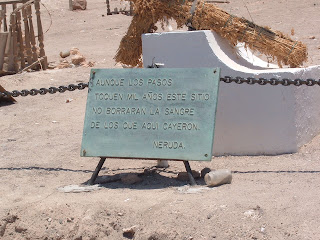
More recently (last year) a new monument has been erected giving the history of the site, and the names of those known to have died whilst incarcerated at Pisagua.
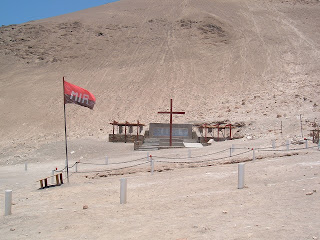
After visiting this sad place, we left Pisagua, up the steep track again, and headed north to Arica. There isn’t much along the Ruta 5, not even a petrol station. Just a few posada, or truck stops.
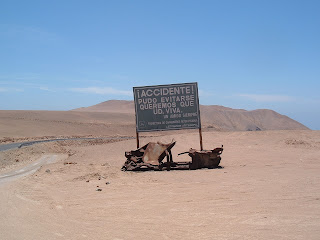
A subtle Chilean warning sign
The Ruta 5 has been mainly flat across the nitrate pampa, but towards Arica, it goes down and up steep hills, high above deep valleys. There were loads of mad bus drivers, hurtling their way to Iquique and Santiago, which is almost a full day’s drive from here.
Eventually we descended into Arica, which is more like a city than Iquique and Antofagasta. Our hotel is on General Valasquez, near the port. To date, we have been used to half deserted hotels, with a few mining engineers or European tourists for company. Here it is packed with families, who mainly seem to come from Bolivia.
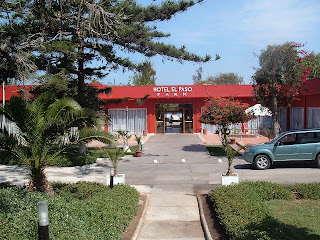
Initially they gave us a room overlooking the pool, but there were loads of kids, music blaring and no privacy, so we asked to change and were given a suite of rooms in the rear of the hotel with two bathrooms and a Jacuzzi.
We walked into town, which was bustling with street traders and taxis. As usual there wasn’t much choice for veggies, so we ate Italian in a wooden building, on a corner. It must have been the worst Italian in the world. Kevin initially ordered “cerveza national” (local beer) and was told they only had Mexican. Joan asked for a wine list, referred to on the main menu, and was told there was no wine. Joan ordered a Pizza Ecologico and they did not have the ingredients. And then when we asked for pepper, they had none of that either. We won’t even talk about the “banos” (toilets.)
We didn’t stay long!!!


